Review·email marketing·Updated July 2026·5 min read
Brevo Review 2026: Multichannel Marketing Between Mailchimp and HubSpot
Brevo combines email, SMS, WhatsApp, forms, automation, and lightweight sales tools in one platform. Its public plans make it accessible to small senders, while advanced automation and reporting move to higher tiers.
Brevo sits between Mailchimp's campaign-first simplicity and HubSpot's broader marketing suite. The platform combines email marketing, SMS and WhatsApp campaigns, forms, automation, and basic sales tools.
The core buying question is whether a team needs those channels in one contact system. Brevo's public feature set supports multistep workflows, segmentation, A/B testing, web and event tracking, and send-time optimization, but access depends on plan.
SMS is integrated into the same platform rather than treated as a separate product, although message credits and country-specific pricing must be modeled separately.
This review uses Brevo's current public product and pricing information. It does not claim a Purple Orange deployment, client result, or measured conversion lift.
What works
Email, SMS, WhatsApp, forms, and automation in one platform
Visual multistep workflow builder on Standard and higher
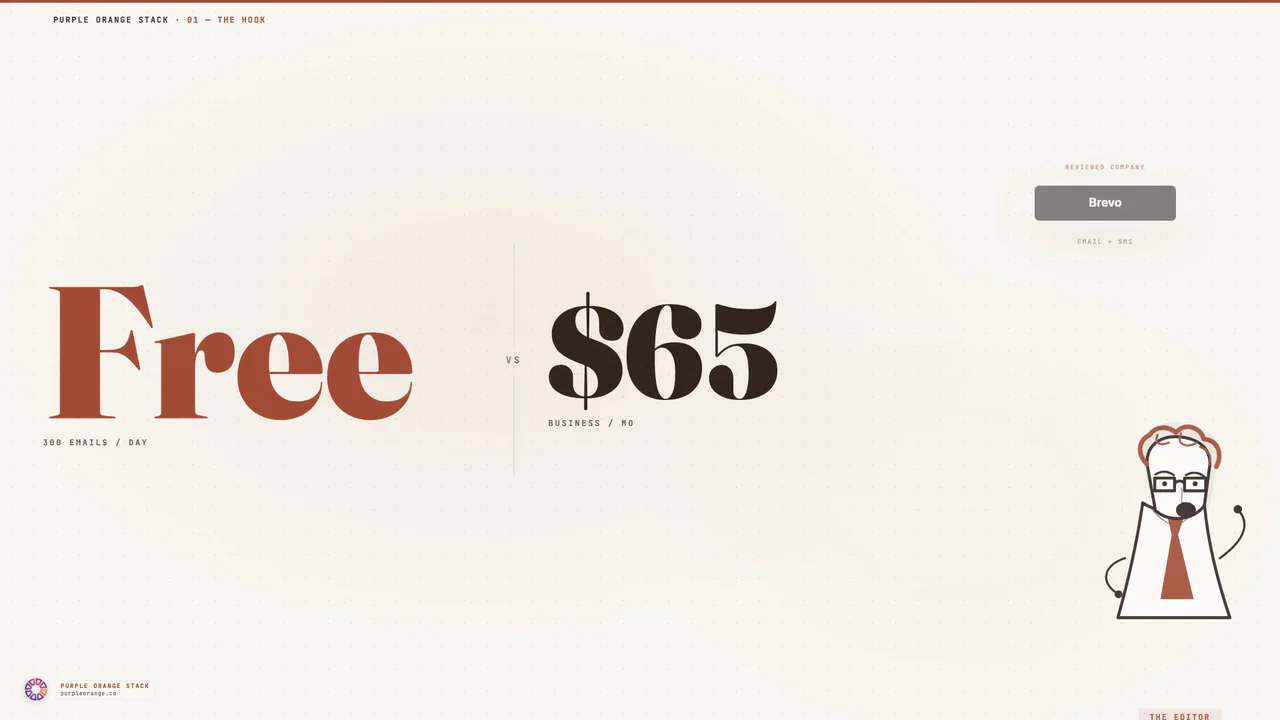
Free tier supports up to 300 email sends daily
Landing-page builder included from Standard
APIs, webhooks, and commerce integrations
What doesn’t
Advanced automation and reporting require Standard or higher
SMS and WhatsApp credits add variable cost
Included sales tools are lighter than a dedicated CRM
Advertisement
Pricing and Plans
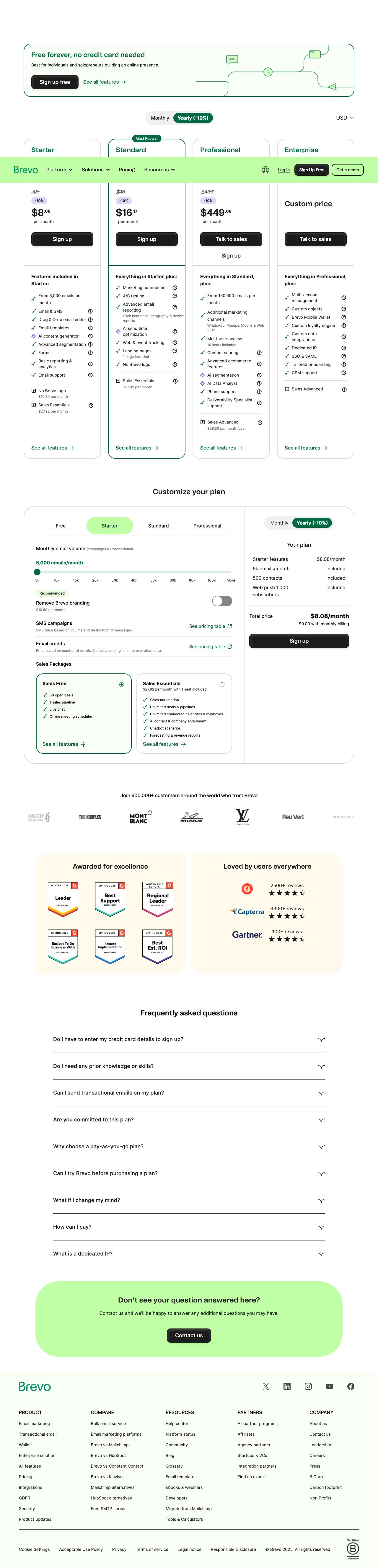
Brevo currently offers Free, Starter, Standard, Professional, and Enterprise marketing plans. The Free tier includes 300 daily email sends. Published monthly starting prices are $9 for Starter, $18 for Standard, and $499 for Professional; Enterprise uses custom pricing.
Plan names matter because automation and reporting access have changed. Starter covers core campaigns and basic reporting, while Standard adds unlimited multistep automation, A/B testing, advanced reporting, web and event tracking, send-time optimization, and a landing page. Professional targets higher-volume, multichannel teams.
SMS and WhatsApp use separate message credits with country-dependent pricing. Extra seats, dedicated IPs, and SSO can also change the total cost, so model the actual send volume and add-ons rather than comparing only the headline monthly price.
Automation and Workflows
Brevo's workflow builder supports multistep automation, delays, conditions, behavioral triggers, and event-based segmentation. Standard is the key public plan boundary for teams that need unlimited automation contacts and A/B testing.
Documented use cases include welcome series, abandoned-cart sequences, event-triggered messages, and multichannel follow-up. The visual editor makes the workflow structure inspectable, but teams should prototype their most complex branch before migrating.
Higher-tier features include contact scoring, dynamic content, ecommerce capabilities, and additional channels. Shopify and WooCommerce integrations are relevant for commerce teams, while webhooks and custom events matter for SaaS use cases.
Deliverability and Performance
Brevo publishes bounce handling, sender-reputation controls, deliverability statistics, and dedicated-IP options. Those tools do not guarantee inbox placement: authentication, consent, list hygiene, engagement, content, and sending cadence still drive outcomes.
New senders should plan a gradual ramp and monitor bounces, complaints, and engagement before increasing volume. High-volume teams should compare dedicated-IP availability and support across Professional and Enterprise.
Brevo's reporting covers delivery and engagement, while Standard and higher plans add more detailed reports. Teams that need advanced attribution or cross-channel analysis should validate those reporting requirements during evaluation.
Integrations and API
Brevo publishes integrations for Shopify, WooCommerce, WordPress, Salesforce, and other common systems, with Zapier, APIs, and webhooks covering additional workflows. Verify the direction, frequency, and field mapping of every required sync.
The included sales tools may suit lightweight contact and pipeline needs, but organizations with complex opportunity management should compare a dedicated CRM. The decision should follow the required data model rather than the convenience of buying one platform.
For custom integrations, review API limits and error handling before moving a high-frequency workflow. A small production-like sync test is more informative than a connector logo.
User Interface and Ease of Use
Brevo organizes campaigns, contacts, automation, and sales tools inside one product, which creates more surface area than a newsletter-only tool. The drag-and-drop editor, reusable sections, forms, and templates cover standard campaign production.
Teams with strict brand systems should test template controls and custom HTML before migrating. Reporting and automation navigation also deserve a trial with the people who will operate them day to day.
Adoption time depends on data cleanup, domain authentication, workflow complexity, and team roles. Build the evaluation around one representative campaign and automation instead of assuming a fixed onboarding timeline.
Research desk · verified pricingCaptured June 2026
Brevo is a credible option for businesses that need email plus SMS, WhatsApp, forms, and multistep automation without buying a full enterprise marketing suite. Standard is the most important comparison tier for many small teams because it unlocks the deeper automation and reporting surface.
Choose a simpler platform if campaign production is the only need, or compare HubSpot when CRM depth and broader revenue operations matter more. Before buying, validate send volume, contact limits, automation access, seats, message credits, reporting, and every required integration.
Answered by The Editor, with notes from Atlas and Roxy.
How does Brevo compare to Mailchimp in 2026?
Brevo emphasizes multichannel automation across email, SMS, WhatsApp, web, and event data. Mailchimp may be simpler for campaign-first teams, while Brevo deserves closer consideration when conditional workflows and multiple channels matter.
Is Brevo's free plan sufficient for small businesses?
The free tier supports 300 email sends per day and basic marketing capabilities. Standard is the first public tier that includes unlimited multistep automation, A/B testing, advanced reporting, and a landing page.
What are Brevo's main limitations?
Advanced automation and reporting move to Standard or higher, SMS and WhatsApp require separate credits, and the included sales tools are lighter than a dedicated CRM. Buyers should also compare template control, seats, contact limits, and dedicated-IP access.
Does Brevo integrate well with e-commerce platforms?
Brevo publishes integrations for Shopify, WooCommerce, and other commerce systems. Validate catalog and customer sync, consent fields, abandoned-cart events, order triggers, and failure handling with the store's actual configuration.
How reliable is Brevo's deliverability?
Deliverability depends on sender reputation, authentication, list quality, content, and sending behavior. Brevo publishes bounce handling and deliverability tooling; high-volume senders should evaluate dedicated-IP availability and warming requirements for their plan.
Is Brevo suitable for advanced marketing automation?
Brevo supports multistep workflows, conditions, behavioral triggers, web and event data, and multiple messaging channels. Standard is the key plan boundary for unlimited multistep automation; teams with complex requirements should prototype their hardest workflow before migrating.
Analytics run in a privacy-safe, cookieless mode by default. Accept to enable
full analytics and personalized ads, which helps keep this research free. See our Privacy Policy.